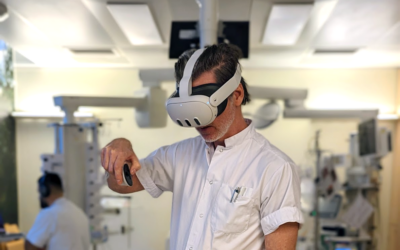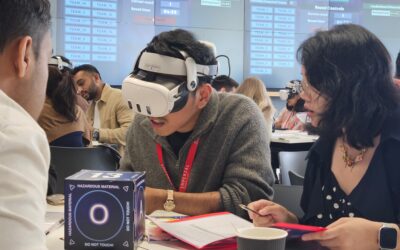

For our October Meetup, we welcomed Richard Lewis, Neuroscientist and Founder/CEO of Brain Man VR, the company behind the VR game Pizza Maths. Richard guided us through the history of Brain Man VR and Pizza Maths, showcased the game’s mechanics, and shared his thoughts on how the game’s potential audience and impact can grow.
ABOUT OUR SPEAKER
While working on his PhD in neuroscience, Richard came into contact with VR and began to integrate it into his work, later going a step further and completing a Master’s Degree in VR. He is also more than familiar with science communication, having spent ten years sharing his knowledge with the public via television, books, and as a keynote speaker.
THE START OF PIZZA MATHS
Inspired by his previous experiences with VR, and eager to combine the fields of VR, neuroscience, AI, and gaming, while delving further into entrepreneurship, Richard partook in a startup incubator in order to set up what would become Brain Man VR.
Three main issues were identified: classroom maths was not sufficiently engaging, pupils’ attention spans seemed to be decreasing, and teachers frequently lacked the necessary time to provide individual support to all students.
To combat these issues, Richard set out to use gamification and VR immersion to keep students engaged while also implementing adaptive AI tutoring to provide this otherwise minimal individual support.
PIZZA MATHS
You may well be wondering, how does the game work? In essence, it focusses upon the challenge of making pizzas. For each pizza, however, the students have to perform different calculations to ensure the pizza is made correctly. These calculations can take the shape of ratios, fractions, and percentages, amongst others.
As demonstrated in the image below, the pizza should have two pieces of pineapple for every seven tomatoes. In this case, there are 14 tomatoes. Students use the keypad to input their answer, get to push a big red button, put their pizza in the oven, and continue on to the next pizza. As Richard explains, this is where his neurological insight comes into play: by frequently repeating such short calculations, students strengthen the neurological pathways which allow them to make these calculations. The more they repeat the calculations, the more their neuroplasticity allows them to improve in their execution.
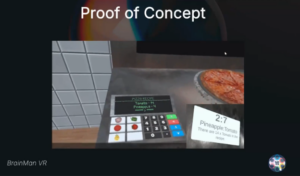
Note: the resolution inside the headset is higher than in this screenshot.
WHAT’S NEXT?
The team behind Pizza Maths aims to expand their concept, adapting other subjects to their pizza game format. Indeed, they have already begun working with students from the University of Leicester to do so. In addition, thus far, the ‘gaming’ sessions with pupils in the target age group (around 13 to 16 years old) have yielded both positive feedback and suggestions to further improve the game’s enjoyability and other schools from around the world have also been reaching out to get involved.
Richard hopes to soon start marketing the game further, expanding its use to tutor platforms and parents in the future. Although originally focused on the UK market, the interest from schools in other countries means that they may expand beyond.
Our sincere thanks to Richard for taking the time to share his project with us and our members. We’re looking forward to hearing about the game’s continued success!