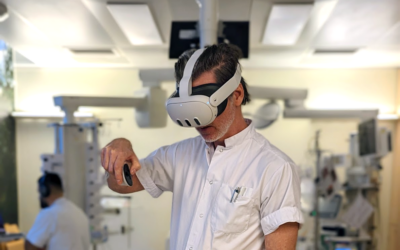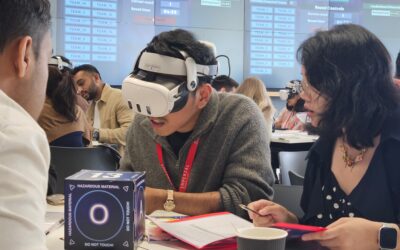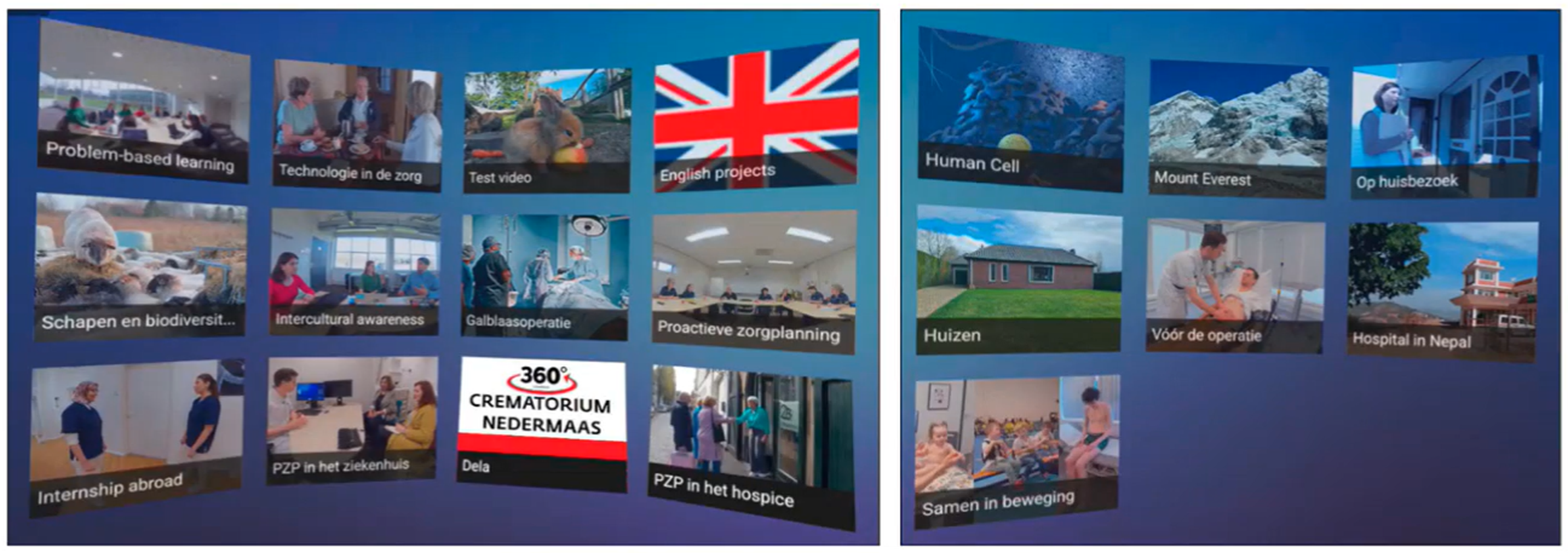

On March 12th, we were delighted to welcome Giorgos Mallinis from the Aristotle University of Thessaloniki (Greece) to present the initiation, development, and implementation of the SURE-VFT project for XR Virtual Field Trips (VFTs) in the university’s Surveying Engineering curriculum. During the Meetup, he explained how digitalising field trips into immersive experiences provides an inclusive, eco-friendly, safe, and cost-effective alternative to traditional physical trips.
ABOUT OUR SPEAKER
Giorgios Mallinis is a professor of Remote Sensing in the School of Rural and Surveying Engineering at the Aristotle University of Thessaloniki (AUTh). He is also a member of the university’s Laboratory of Photogrammetry and Remote Sensing.
The Start of SURE-VFT
A collaboration between KIKLO, EuroXR, and AUTh, the SURE-VFT project is part of XR4ED – an EU-funded education platform dedicated to creating scalable, accessible, and impactful learning experiences by means of XR technologies. In 2024, they awarded Giorgos and his colleagues a grant to incorporate XR in the Surveying Engineering curriculum. In doing so, their aim was to develop tools to increase sustainability, practical skills, and accessibility within and beyond the surveying engineering field.
Why Use XR in Surveying Engineering?
Giorgos explained that within surveying engineering education and research, there was a need for better visualisations, improved tools for error detection, and more time- and cost-effective options for field trips. Not only could XR meet those needs, it could also provide opportunities for safe experimentation and repeated practice, consequently increasing flexible learning. In addition, as XR can be very intuitive, it serves as a great medium for explaining complex aspects in surveying engineering to non-experts, including students.
And so, the SURE-VFT project took off. After an extensive preparation phase including an in-depth literature review and several questionnaires, Giorgos and his team were well-prepared and aware of the students’ and teachers’ needs going forward.

All image credits to Giorgos Mallinis.
Virtual Field Trips
The software used to upload and access the VFTs is Portal Hopper, which anyone can download for free via the XR4ED platform. The trips can be downloaded after logging into the app. As part of the SURE-VFT project, three virtual trips were developed, two of which are briefly explained below. Both are compatible with a desktop computer, making them very accessible to interested users.
PHOTOGRAMMETRY VIRTUAL FIELD TRIP
In photogrammetry, multiple, overlapping 2D images of an object from different angles are translated into an accurate 3D model using specialised software. The aim of the photogrammetry VFT was to familiarise students with this practice. To do so, Giorgos and his team created an immersive environment containing a 3D model of the weather observatory of the Aristotle University of Thessaloniki. There were five pins on the digital building corresponding to five ground control points (GPCs). After interacting with the GCPs, students were shown a selection of photos of the observatory taken from different angles. Their job was to align the position of these images with the positions of the pins on the 3D model by either accepting or denying each photo in the selection. The VFT was completed after students correctly matched each image from the GPC with its corresponding pin.

LULC MAPPING FOR REMOTE SENSING
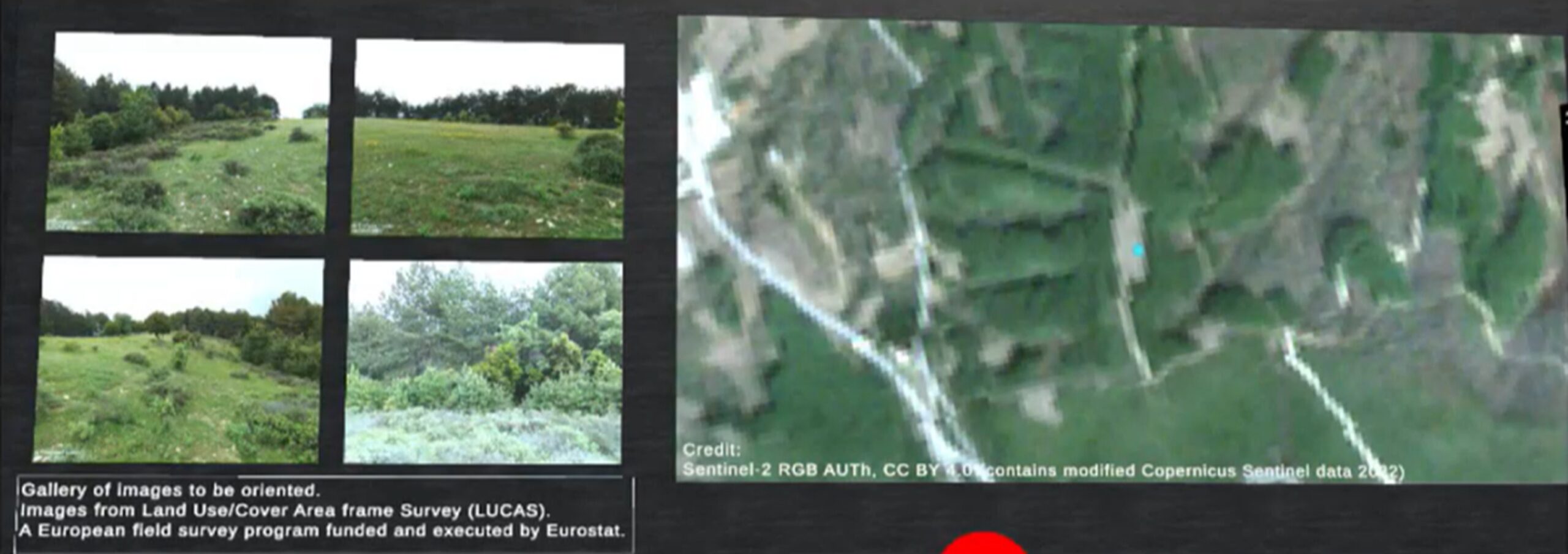
This second VFT was developed to familiarise students with different Land Use/Land Cover (LULC) types, such as grassland, agriculture, or artificial. Students could practice identifying these types by analysing multiple sources of information, including satellite imagery, field photos, and geospatial data. In the first step, they were tasked to map the correct cardinal directions to four ground images using one satellite image. Afterwards, they had to select which land cover class matched the images. Once they successfully completed these tasks for all samples, the training was over. The students had access to a workflow and instructions to guide them through the entire process.
We would like to sincerely thank Giorgos for his inspiring and in-depth presentation! You can find the VFTs via this link. To access the recording of the full presentation, please don’t hesitate to contact us via xrcommunity@llinc.leidenuniv.nl.